Nov 4
Should I Update My Training Program?
The Benefits of Modernization

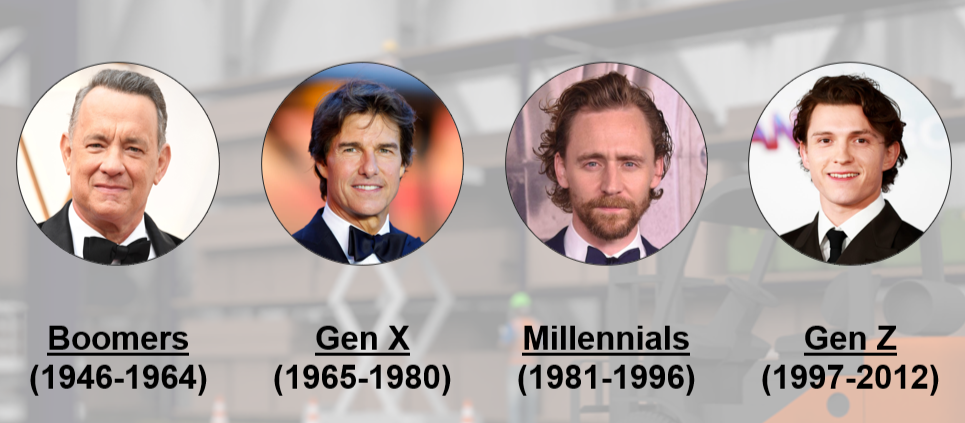
Across today’s industrial workforce, one of the most overlooked challenges is providing training that sticks despite generational diversity. For the first time in modern history1, our workplaces include four distinct generations working side by side (an example of the differing generations can be seen in each era’s “Tom”):
Each group brings its own strengths, learning preferences, and levels of technological comfort to the workforce. As per the Toms, you wouldn’t treat any of these Toms exactly the same.
Baby Boomers tend to be less tech-savvy, favoring hands-on approaches to learning. They are practical and prefer training that connects directly to real-world experience. Generation X is often skeptical of trends and focuses on what is efficient and useful. Younger generations (Millennials and Gen Z) grew up with smartphones, YouTube, and video games. They are used to learning from fast, visual, interactive media. Research confirms this: younger generations are far more accustomed to digital and visual learning.
- Baby Boomers (1946–1964) characterized by Tom Hanks
- Generation X (1965–1980) characterized by Tom Cruise
- Millennials (1981–1996) characterized by Tom Hiddleston
- Generation Z (1997–2012) characterized by Tom Holland
Each group brings its own strengths, learning preferences, and levels of technological comfort to the workforce. As per the Toms, you wouldn’t treat any of these Toms exactly the same.
Baby Boomers tend to be less tech-savvy, favoring hands-on approaches to learning. They are practical and prefer training that connects directly to real-world experience. Generation X is often skeptical of trends and focuses on what is efficient and useful. Younger generations (Millennials and Gen Z) grew up with smartphones, YouTube, and video games. They are used to learning from fast, visual, interactive media. Research confirms this: younger generations are far more accustomed to digital and visual learning.

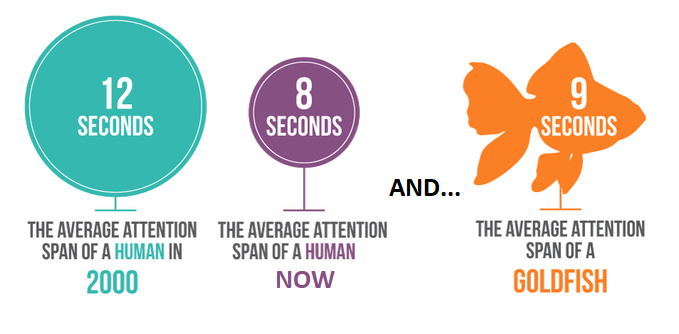
Source: Microsoft Attention Spans Report (2015); image adapted from InGenius Hub (2018).2
8 Second Attention Span
Here’s a striking example: attention span. Studies suggest the average Gen Z or Millennial attention span is about eight seconds—shorter than a goldfish!3 Now, that doesn’t mean they can’t pay attention; it means they’ve learned to filter information very quickly. If something is boring or irrelevant, they move on almost instantly.
When we look at learning styles, every generation brings something different. Some are primarily auditory learners, others visual, and some prefer interactive environments. What unites all generations is a survival instinct for learning and the need for information to be relevant, memorable, and applicable. If a safety training feels like a boring formality, people’s brains go on autopilot. This is by design. Humans are wired to learn in real time, by interacting with our environment, after all, for most of our evolutionary history, survival depended on it.
Traditional safety training often struggles to meet these diverse needs. Many programs rely on passive instruction (i.e. slide decks, videos, or long classroom sessions) which doesn’t capture attention across all groups. The result is disengagement, low retention, and inconsistent application of procedures in the field.
When we look at learning styles, every generation brings something different. Some are primarily auditory learners, others visual, and some prefer interactive environments. What unites all generations is a survival instinct for learning and the need for information to be relevant, memorable, and applicable. If a safety training feels like a boring formality, people’s brains go on autopilot. This is by design. Humans are wired to learn in real time, by interacting with our environment, after all, for most of our evolutionary history, survival depended on it.
Traditional safety training often struggles to meet these diverse needs. Many programs rely on passive instruction (i.e. slide decks, videos, or long classroom sessions) which doesn’t capture attention across all groups. The result is disengagement, low retention, and inconsistent application of procedures in the field.
Studies show how critical engagement is to learning outcomes. Motivation improves when training is realistic (digital twins and simulations based in real scenarios) and immersive (interactive and participatory) .4
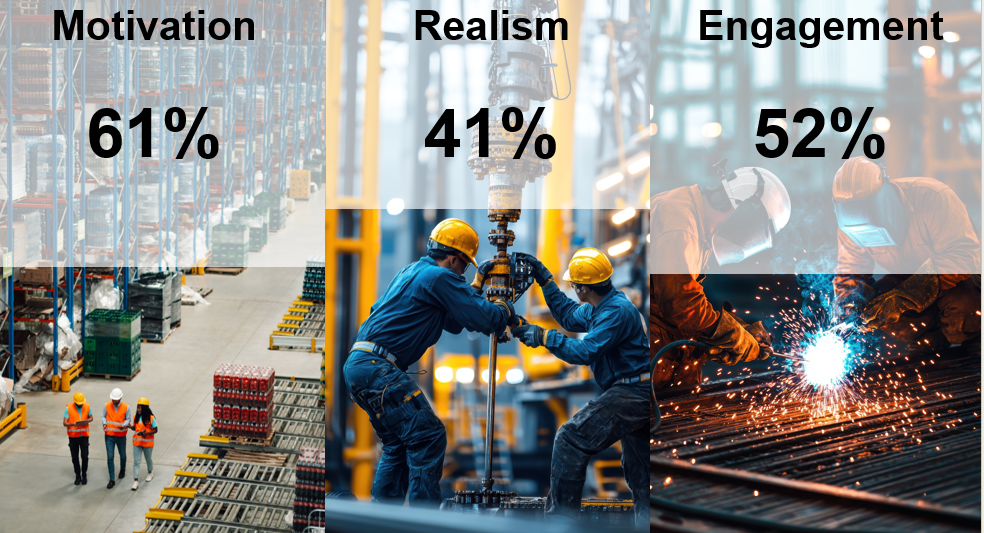
Per our own data, we saw that traditional methods of training showed that roughly 61% of employees feel motivated in participating in safety training (they find it to be a "waste of time"), Our studies also find that only 41% think traditional training is realistic or tailored to their actual jobs. This research also states that just over half (52%) of employees truly feeling engaged in their current safety training.
Now when we introduced interactive and gamified learning elements, those numbers jumped dramatically: We saw motivation rise to 86%, realism to 82% and engagement jumps all the way to 88%.
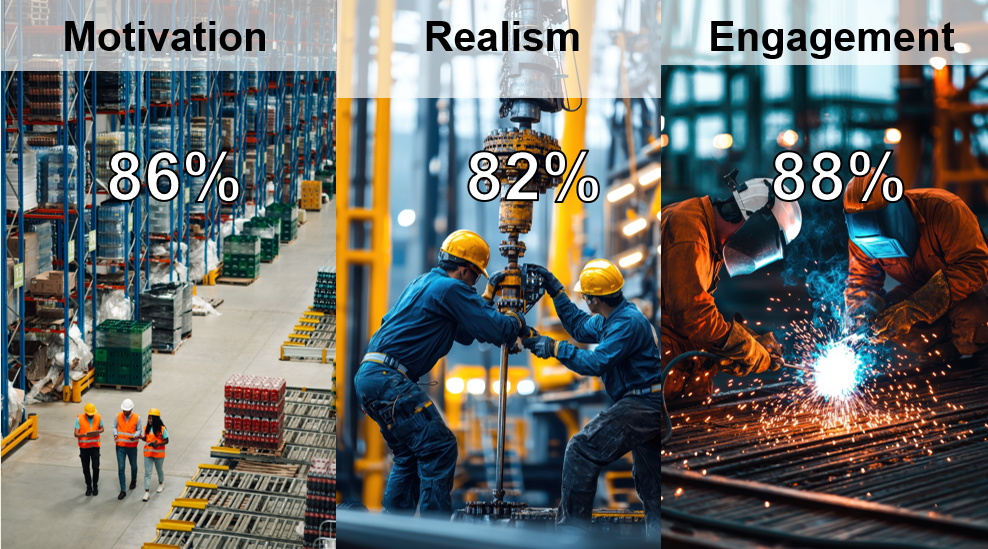
These results show that when learners can interact, explore, and make decisions in a safe environment, they not only understand the material better, but they retain it longer.
In fact, on average, a learner retains only about 10% of what they hear in a lecture after three days. That means 90% of that safety briefing you delivered Monday might be gone by Thursday. Even adding visuals (hearing plus seeing) only brings retention up to about 50%. But if you involve learners actively, retention can skyrocket to around 90% even after a few days.5
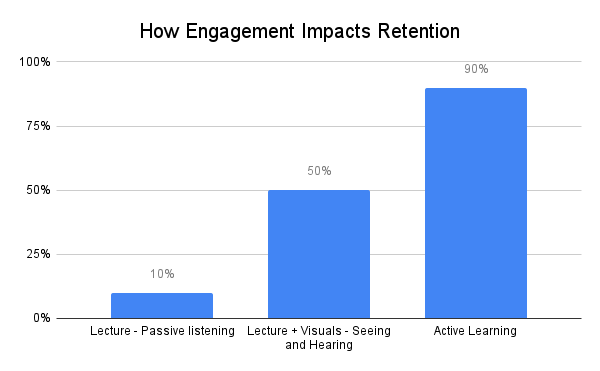
Why is active learning so much better? Because it engages people. When you’re doing something such as problem solving, your brain is turned on. Traditional training, unfortunately, often struggles to engage, especially younger people who are used to interactivity.
To successfully bring these methods into an organization, four key steps can help guide implementation.
- Leadership and Operations Buy-In – leadership/operations buy in; start with highest leverage; use legacy conversions; help them realize cost is not any higher.
- Train and Modify the Technology – train the tech and offer variations.
- Mix Methods – combine digital training with traditional training.
- Start with the Best Topic – start with the highest leverage, usually meaning digital twins
We’ll discuss this concept much further in Part 6.
The workforce may span generations, but the goal is the same: ensuring everyone goes home safe at the end of the day. By leveraging technology, realism, and engagement, training can once again become something people look forward to as an experience that connects every generation through the shared responsibility of safety.
The call to action I’ll leave you with is this: don’t settle for training that only checks a box. If you’re in a position to influence how your organization trains its people, try one thing: introduce a gamified or interactive element in your next training cycle. See the difference. Measure the difference. You might be pleasantly surprised by how much more engaged your workforce becomes and by the safety improvements that follow.
When we update how we train our teams, we make safety training something that people can look forward to; something that truly sticks with them and saves lives by preventing the next accident. Bridging the generation gap is possible; we’ve seen even seasoned foremen and young techs alike get excited about a well-designed safety game. Modernization can bring teams together to transfer knowledge more effectively and create a greater safety culture.
We started this journey with an Introduction last week. Follow along week by week for our "8 Steps to Modernize Training".
Interested in learning more? Reach out to us here: calendly
Sources:
1. Tanner, Robert. “Understanding and Managing the 4 Generations in the Workplace.” Management is a Journey, 26 Jan. 2025, https://managementisajourney.com/understanding-and-managing-the-4-generations-in-the-workplace/
2. InGenius Hub (2018) — Human vs Goldfish Attention Span Research
3. Microsoft Canada. Attention Spans: Consumer Insights. Microsoft Advertising, 2015.
4. “The Learning Pyramid,” National Training Laboratories Institute for Applied Behavioral Science (NTL Institute), Bethel, Maine — circa 1960s–70s.
5. TalentLMS (2019). Gamification in the Workplace Survey.
Welcome!
Please find on this page your required safety trainings.
Note that you will find both English and Spanish versions of courses. You will only be required to take one or the other.