Aug 22

Part One: Separator Fundamentals


4 min read
Field hands check a separator on every shift, but most are never taught why and how it separates.

A wellstream enters the separator as one turbulent mix, and everything downstream depends on what happens between the inlet and the outlets.

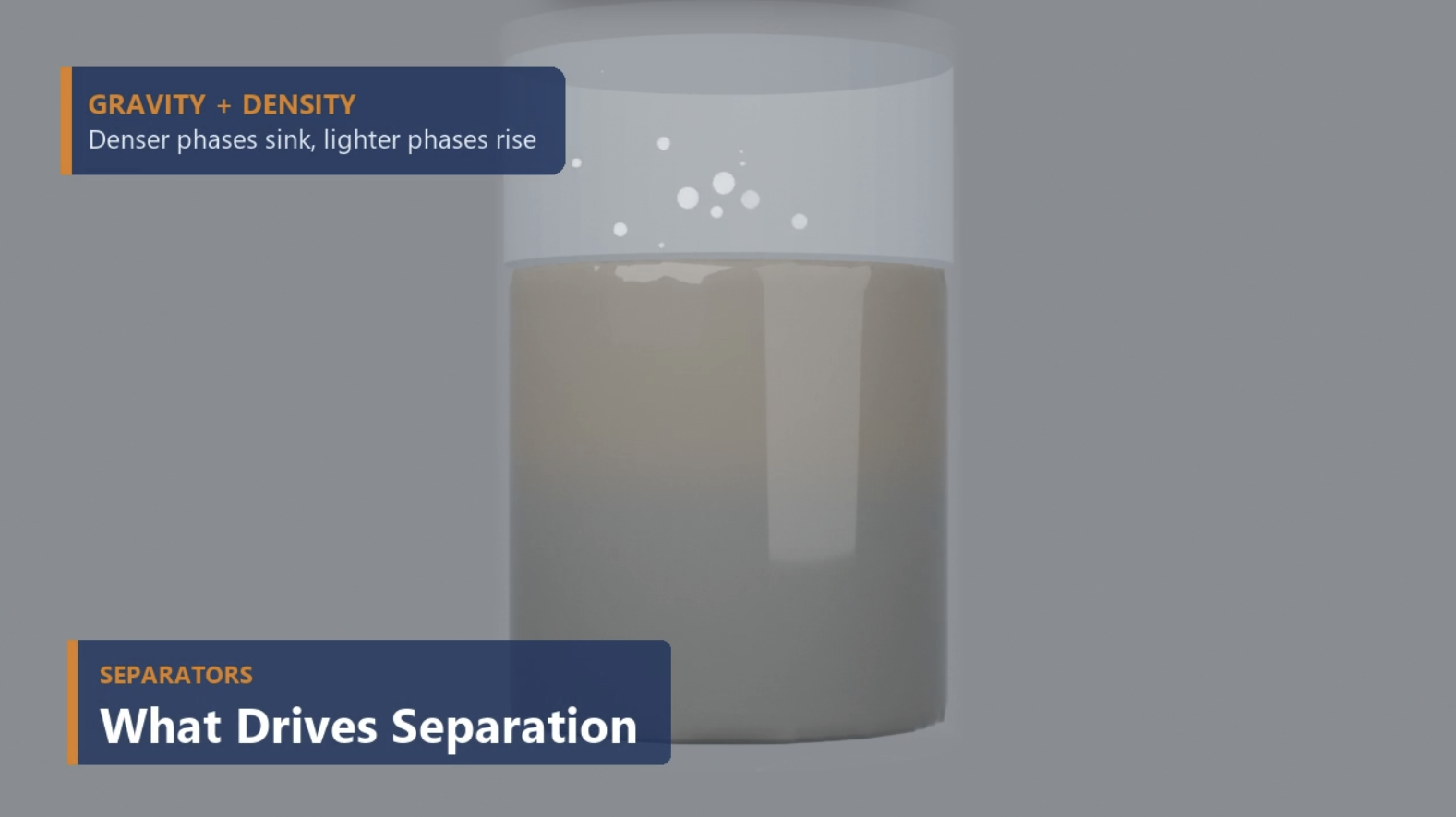
Two things make separation happen. Gravity and residence time do the separating, gas splits off fast, while oil and water need more time since they're closer in density. Pressure does the moving, the vessel holds well above atmospheric, and a back pressure valve on the gas outlet is what actually pushes separated liquid out to the next piece of equipment.

Miss either one: separation without enough time, or pressure without enough control, and the stream will fail to separate into three clean products. 

Watch the full video

Get instant access to the separator fundamentals module.
Enter your email below to stream it.
Part One: Separator Fundamentals

What the training covers

What separates the phases in the first place

Separation inside the vessel isn't powered by anything mechanical, it's gravity acting on the difference in density between the phases. Gas is far less dense than liquid, so gas and liquid pull apart quickly with almost no help needed. Oil and water are a different story, they sit much closer together in density, so they separate slowly and need residence time inside the vessel to finish the job.

Droplet size plays into this too, and it's the reason a separator isn't just an empty tank. The training module covers which internals force smaller droplets together so they can settle out on a timeline the vessel can actually work with.
Write your awesome label here.

What happens to the stream once it's inside

The stream's first stop inside the vessel breaks its momentum the moment it arrives, dropping most of the liquid out of the gas right away. Gas continues up toward the outlet, passing through internals built to catch what gravity alone can't. The liquid settles below, held long enough for gravity to keep separating.

From there, the path depends on how many phases the vessel is built to handle. A two-phase separator sends all of that liquid out through a single outlet. A three-phase separator differentiates further, using an internal that lets oil continue separating from water before each one leaves through its own outlet.
Write your awesome label here.

What gets liquid out the door

None of the separation work matters if the liquid never leaves the vessel downstream, and that's where pressure comes in. As liquid rises inside the vessel, it changes the pressure holding above it, and that pressure pushes liquid out through the outlet. The training walks through the process step by step, explaining why pressure climbs, why it falls, and what that means for keeping the vessel running.

This whole cycle is set and held by the back pressure valve on the gas outlet. Hold gas back, and pressure rises. Let more of it out, and pressure falls. The valve isn't just controlling gas, it's controlling whether the vessel keeps just enough pressure to move its own liquid along to the next piece of equipment.

Write your awesome label here.

"A separator doesn't just split gas, oil, and water apart, it has to hold enough pressure to actually get them out the door."

What the full training covers:

  1. Why We Separate
  2. What Drives Separation
  3. How a Separator Works
  4. Back Pressure

Interested in building this kind of training for your operations team?
Fill out the form below to request a virtual demo with our team


Want to bring this training to your entire team?
Fill out the form below to schedule a 30-minute personalized demo.

read related blogs

More on Operations Training

Est. 4 min read
Part Two: Separator Internals
__ August, 2026

Est. 4 min read
Part Three: Separator Accessories
__ August, 2026

Get biweekly operational breakdowns delivered to your inbox

Join a network of operational leaders receiving biweekly updates on trends, animations, trainings, and strategies.