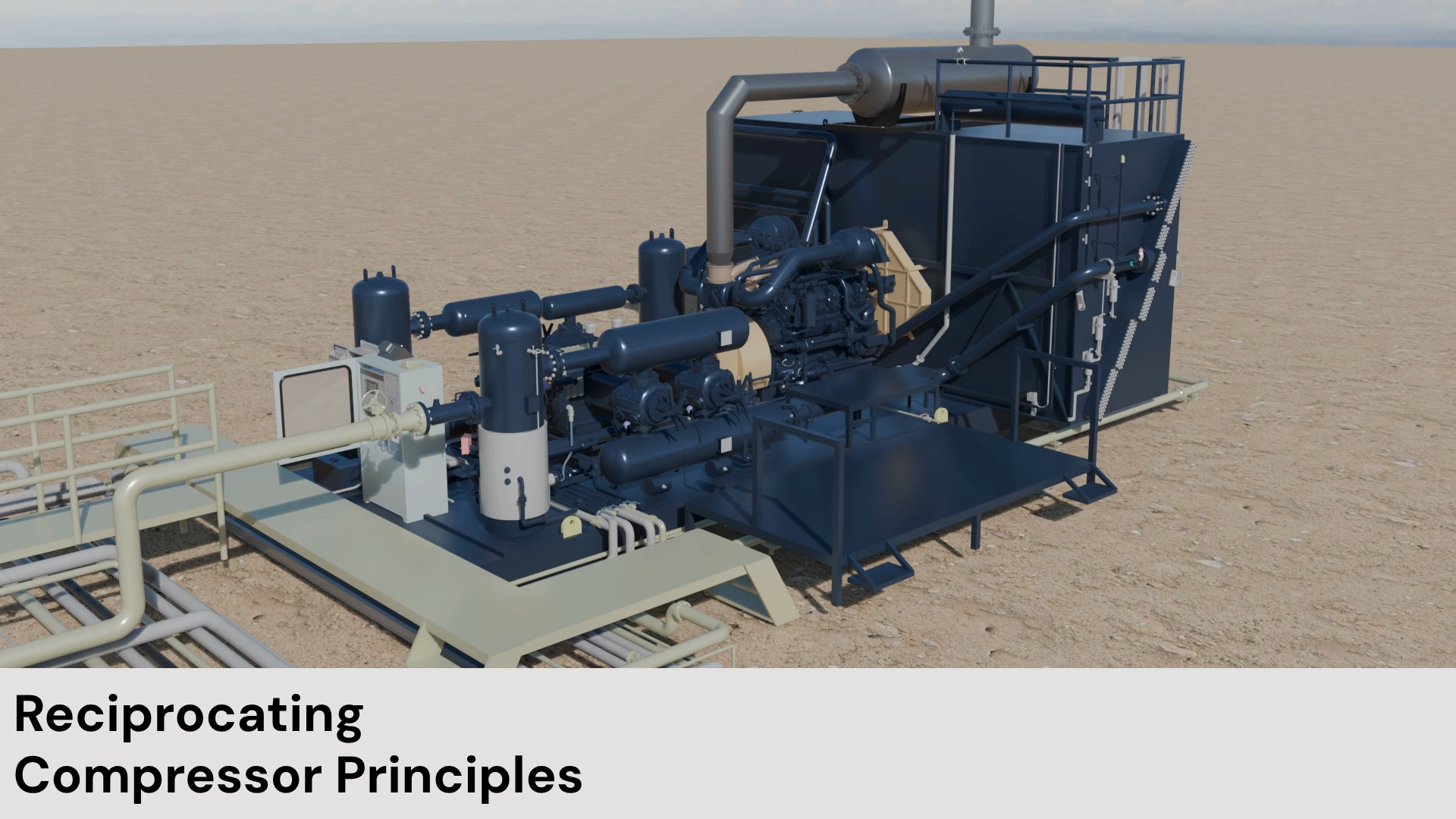
Reciprocating compressors are positive displacement machines. A piston moves back and forth inside a cylinder, displacing a fixed volume of gas per stroke. Simple in concept, but the details matter in the field. Most operators know the rough idea. Fewer can explain what determines when a suction valve opens, what the head end and crank end are each doing at a given point in the stroke, or why a double-acting unit compresses on both strokes simultaneously.
Understanding the full stroke cycle is what lets an operator interpret a pressure reading correctly, recognize a valve anomaly early, or diagnose sluggish performance before it becomes a failure.
Three things keep a reciprocating compressor running: lubrication, cooling, and proper capacity control. Operators are involved in all three.
On heavy-duty units, cylinders are water-jacketed and connected to aerial radiators. On multi-stage units, the same cooler also houses intercoolers that cool the gas between stages. That step is where condensate forms. Any liquid that gets past the interstage scrubber and into the next cylinder is among the most common causes of valve and crosshead failures in the field.
Capacity control is where misapplied adjustments create problems. Clearance pockets and valve unloaders both change how much work the piston does per stroke. Used correctly, they let operators match output to changing field conditions. Used without understanding the underlying mechanics, they can accelerate wear or drive liquid into a stage that can't handle it.
The drive unit converts rotary motion into the reciprocating motion that drives the pistons. In a balanced-opposed configuration, cylinders on opposite ends fire in opposing directions so forces cancel at the crankshaft. Knowing this helps operators distinguish normal vibration patterns from crosshead or bearing issues worth investigating.
Multi-stage compression is where the highest-consequence failures concentrate. Gas enters the first stage through a suction scrubber, gets compressed and heated, then passes through an aerial cooler before the next stage. Each cooling step forms more condensate. Each scrubber is the last line of defense before the next set of cylinders. When that system is working, it's invisible. When it isn't, damage is fast and repairs are expensive.