Aug 31

Part Three: Separator Accessories


4 min read
Maintaining an accessory isn't for a backup plan, it's how you determine if the vessel is functioning properly.

Part One covered why a separator splits the wellstream apart, and Part Two opened up the internals. Both explain what the vessel should be doing, but neither one identifies whether it's actually functioning properly. The accessories that lie external to the vessel are what identify that, and all three work together as one system, not as pieces that can be evaluated on their own.

Knowing you're required to check something isn't the same as knowing why it's off, and that gap turns a two-minute fix into a loss of production while you wait and call for help. Part Three closes out the series with mitigating that gap.

Watch the training now

Get instant access to the separator accessories module.
Enter your email below to stream it.
Part Three: Separator Accessories

What the training covers

Reading the vessel's basic instruments

A sight glass shows you the oil level and, on a three-phase vessel, the oil-water interface. However, that reading is accurate only if the glass is clean and opened correctly. Additionally, a level controller acts on what it senses through a displacer, a mechanical link that can fail quietly. If it does, the controller doesn't stop and keeps acting on whatever position it's stuck in, confidently managing a level that no longer reflects what's actually in the vessel. A three-phase separator runs two of these, one for oil and one for water, and either can fail the same way. The training walks through how that mechanical chain works and where it breaks.
Write your awesome label here.

What each accessory protects, and what it looks like when one fails

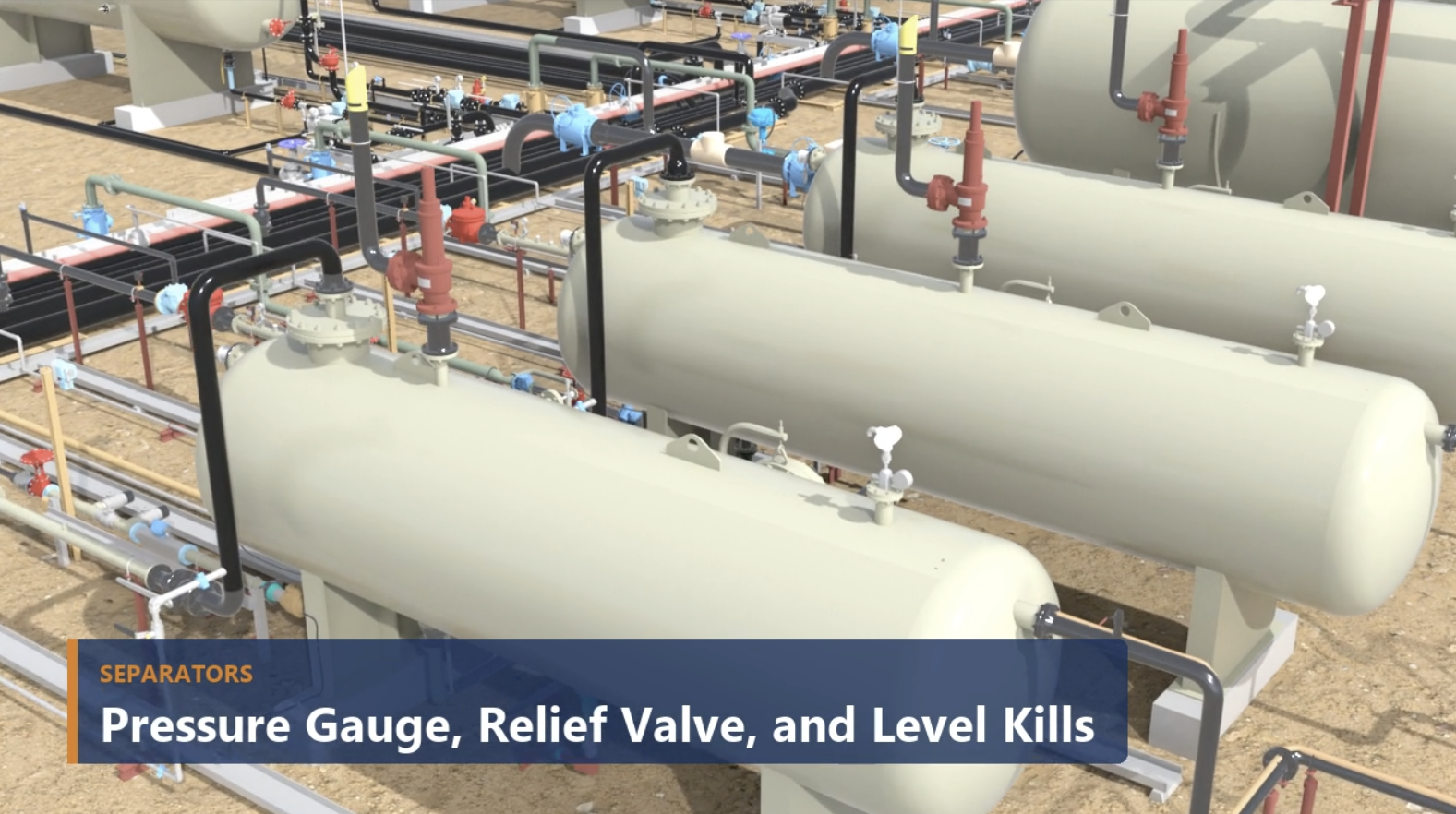
Three devices generally protect the vessel and the process, each guarding a different failure: the pressure gauge, a high level kill, a low level kill, and the relief valve, the vessel's last line of defense at its maximum allowable working pressure. The training dives into what each one is watching for and when it's supposed to act.

In the field, a failed accessory shows up as one of two patterns. Gas out the dump line usually means the displacer has fallen off, and liquid out the gas line means the level rose too high before the high level kill caught it. The training covers the reasons these failures can happen, how to tell which one you're looking at, and strategies to fix them.
Write your awesome label here.

Why a well test needs its own separator

On a multi-well pad, a sales meter reads only the combined total for every well on the pad, and can't tell you what any single well is actually producing. A well test isolates one well into a dedicated test separator so per-well numbers an be measured and used for targeting work needs, production allocation, royalties, and decline tracking.

The valve lineup takes center stage during a well test, as getting the sequence wrong can deadhead the well, shut in against itself with nowhere for pressure to go. Accessories still play a major role as gauges or kills catch when a device has failed. Nothing catches a valve lineup done out of sequence except the person doing it, so training what that correct sequence looks like is critical.

Write your awesome label here.

"Every separator has three lines of defense: a gauge you check, level kills that shut it in, and a relief valve at its maximum working pressure."

What the full training covers:

  1. Sight Glasses and Gauge Cocks
  2. Level Controllers and Dump Valves
  3. Gauge, Relief Valve, and Level Kills
  4. Well Testing
  5. Common Issues

Interested in building this kind of training for your operations team?
Fill out the form below to request a virtual demo with our team


Want to bring this training to your entire team?
Fill out the form below to schedule a 30-minute personalized demo.

read related blogs

More on Operations Training

Est. 4 min read
Part One: Separator Fundamentals
__ August, 2026

Est. 4 min read
Part Two: Separator Internals
__ August, 2026

Get biweekly operational breakdowns delivered to your inbox

Join a network of operational leaders receiving biweekly updates on trends, animations, trainings, and strategies.