Aug 28

Part Two: Separator Internals


4 min read
Stepping inside the shell to understand how each component supports separation.

From the outside, a separator is just a vessel with pipes running in and out. But everything that decides whether it actually works is happening on the inside: inlet diverters, coalescing plates, wave baffles, vane packs and mesh pads, weir plates, and vortex breakers. Each component hosts a critical function that either supports the flow or prevents an undoing of the separator's job.

An operator can run a vessel correctly for an entire career without ever watching any of that happen. Seeing it in motion is what turns a steel shell into something field crew actually understand.

Watch the internal flows

Get instant access to the vessel internals module.
Enter your email below to stream it.
Part Two: Separator Internals

What the training covers

Taming the incoming stream

The wellstream arrives at the inlet moving fast, and velocity works against everything a separator is trying to do. The first thing it meets inside the vessel is the inlet diverter, which breaks the stream's momentum and drops most of the liquid out of the gas immediately.

As the liquid is settling, it needs to stay calm, and the waves surging on the surface throw off both separation and every controller reading that level downstream. This is where a wave baffle comes in to keep the liquid surface calm enough for the layers to hold and the controls to read them accurately.
Write your awesome label here.

Pulling droplets out of the gas

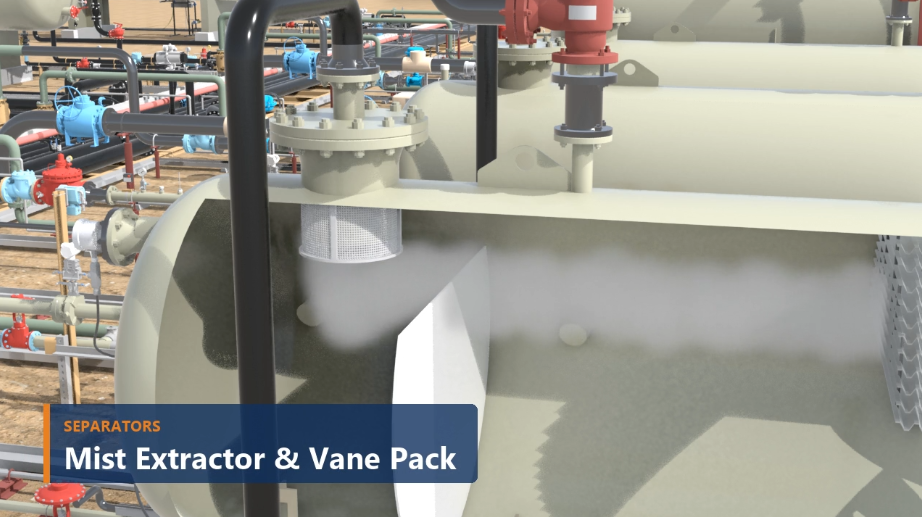
Gas leaving the top of the vessel still carries small liquid droplets with it, and gravity alone is not enough because those droplets are too small to settle out on their own in the time the gas spends inside the vessel. Therefore, the separator forces the issue instead with a vane pack and a mesh pad, two internals built to make droplets collect and combine instead of just filtering them out. The training animates the process and explains how each component enforces that.
Write your awesome label here.

Keeping oil and water on their own sides

In a three-phase separator, oil and water settle out by gravity, with oil floating on top. The vessel still needs a way to pull that oil off without dragging water along with it, and that's the weir plate's entire job. As oil rises high enough, the weir plate stands as a divider for the oil to spill over into its own compartment while water stays behind. The training covers how the weir is positioned and sized to make that split hold up.

Oil then leaves through the oil compartment's own outlet, while water leaves through the main compartment's outlet. As the liquids head downstream, a vortex breaker sits over each outlet nozzle to stop them from swirling on the way out, since a swirl at the outlet would recombine layers and undo all the work the separator just accomplished.

Write your awesome label here.

"A swirl that turns into a vortex pulls whatever's sitting above the liquid down with it, undoing the separation the vessel just performed."

What the full training covers:

  1. Inlet Diverter and Wave Baffle
  2. Mist Extractor and Vane Pack
  3. The Weir and Oil Compartment
  4. Vortex Breakers

Interested in building this kind of training for your operations team?
Fill out the form below to request a virtual demo with our team


Want to bring this training to your entire team?
Fill out the form below to schedule a 30-minute personalized demo.

read related blogs

More on Operations Training

Est. 4 min read
Part Three: Separator Accessories
__ August, 2026

Est. 4 min read
Part One: Separator Fundamentals
__ August, 2026
Est. 4 min read
Multi-Well Gas Lift Operations
18 September, 2024

Get biweekly operational breakdowns delivered to your inbox

Join a network of operational leaders receiving biweekly updates on trends, animations, trainings, and strategies.